Log #60
“The architecture we inhabit, the urban systems we rely on, and the landscapes we transform are all part of the technosphere,” write Albert Pope and Brittany Utting, guest editors of Log 60: The Sixth Sphere. For them, the sixth sphere is the technosphere, an emergent man-made system entangled with the Earth’s five natural spheres: the atmosphere, hydrosphere, biosphere, cryosphere, and lithosphere. “Taken as a whole, the technosphere includes our feedlots and sewer systems, factories and housing, tarmacs and croplands, and every modification we have made to the ground, the glaciers, the sea, the air, and the biosphere. It is a vast and often banal landscape. . . . Almost everything we do – prepare a meal, buy a shirt, message a colleague, fill a prescription, take a bath – we do through the technosphere.”
Log 60, a 208-page thematic issue, explores the technosphere as “a planetary enmeshment of bodies, environments, and technologies” by examining the Earth’s natural spheres through the lenses of architecture, science, and philosophy. Geologist Peter K. Haff defines the technosphere; architect Rafael Beneytez-Duran, philosopher Emanuele Coccia, and historian Ingrid Halland each consider how we occupy and breathe the atmosphere; architects Alexandra Arènes, Daniel Jacobs, Brittany Utting, Lydia Kallipoliti, Andreas Theodoridis, and Neyran Turan take on the scope of the biosphere; architects Margarita Jover, Marina Tabassum, and Maggie Tsang wade through the history and challenges of the hydrosphere; anthropologist Dominic Boyer, landscape architect Leena Cho, and architects Billy Fleming, Joyce Hsiang, and Bimal Mendis take stock of the possible futures of the cryosphere; and climate researcher Holly Jean Buck, architects Rania Ghosn, Ang Li, and Marina Otero Verzier each dig into the possibilities in the lithosphere. As the guest editors write: “Log 60 positions the technosphere not only as a geophysical condition to understand and critique but also as a collective site in which to construct alternative social, technical, and environmental futures.”
Product Information
Product Information
Shipping & Returns
Shipping & Returns
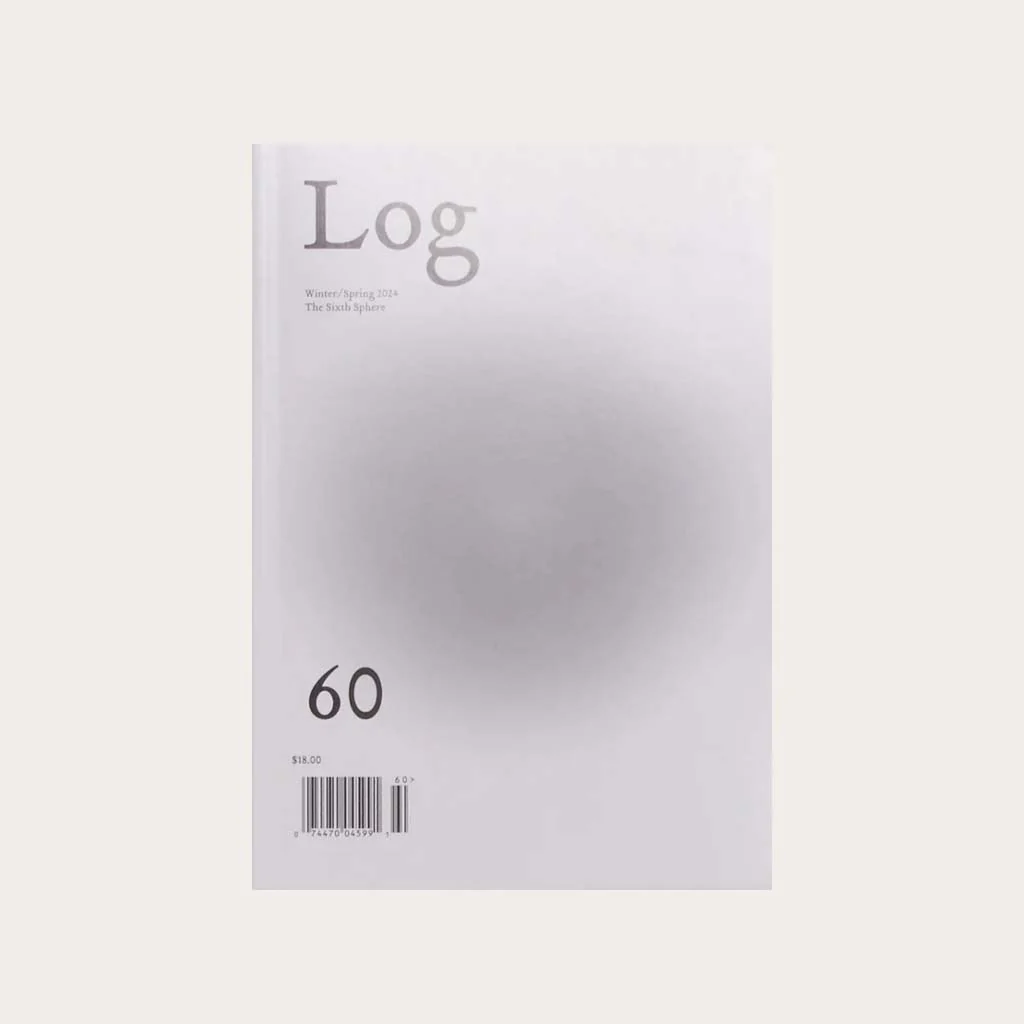
Log #60
Log #60
“The architecture we inhabit, the urban systems we rely on, and the landscapes we transform are all part of the technosphere,” write Albert Pope and Brittany Utting, guest editors of Log 60: The Sixth Sphere. For them, the sixth sphere is the technosphere, an emergent man-made system entangled with the Earth’s five natural spheres: the atmosphere, hydrosphere, biosphere, cryosphere, and lithosphere. “Taken as a whole, the technosphere includes our feedlots and sewer systems, factories and housing, tarmacs and croplands, and every modification we have made to the ground, the glaciers, the sea, the air, and the biosphere. It is a vast and often banal landscape. . . . Almost everything we do – prepare a meal, buy a shirt, message a colleague, fill a prescription, take a bath – we do through the technosphere.”
Log 60, a 208-page thematic issue, explores the technosphere as “a planetary enmeshment of bodies, environments, and technologies” by examining the Earth’s natural spheres through the lenses of architecture, science, and philosophy. Geologist Peter K. Haff defines the technosphere; architect Rafael Beneytez-Duran, philosopher Emanuele Coccia, and historian Ingrid Halland each consider how we occupy and breathe the atmosphere; architects Alexandra Arènes, Daniel Jacobs, Brittany Utting, Lydia Kallipoliti, Andreas Theodoridis, and Neyran Turan take on the scope of the biosphere; architects Margarita Jover, Marina Tabassum, and Maggie Tsang wade through the history and challenges of the hydrosphere; anthropologist Dominic Boyer, landscape architect Leena Cho, and architects Billy Fleming, Joyce Hsiang, and Bimal Mendis take stock of the possible futures of the cryosphere; and climate researcher Holly Jean Buck, architects Rania Ghosn, Ang Li, and Marina Otero Verzier each dig into the possibilities in the lithosphere. As the guest editors write: “Log 60 positions the technosphere not only as a geophysical condition to understand and critique but also as a collective site in which to construct alternative social, technical, and environmental futures.”
Original: $28.00
-65%$28.00
$9.80Product Information
Product Information
Shipping & Returns
Shipping & Returns
Description
“The architecture we inhabit, the urban systems we rely on, and the landscapes we transform are all part of the technosphere,” write Albert Pope and Brittany Utting, guest editors of Log 60: The Sixth Sphere. For them, the sixth sphere is the technosphere, an emergent man-made system entangled with the Earth’s five natural spheres: the atmosphere, hydrosphere, biosphere, cryosphere, and lithosphere. “Taken as a whole, the technosphere includes our feedlots and sewer systems, factories and housing, tarmacs and croplands, and every modification we have made to the ground, the glaciers, the sea, the air, and the biosphere. It is a vast and often banal landscape. . . . Almost everything we do – prepare a meal, buy a shirt, message a colleague, fill a prescription, take a bath – we do through the technosphere.”
Log 60, a 208-page thematic issue, explores the technosphere as “a planetary enmeshment of bodies, environments, and technologies” by examining the Earth’s natural spheres through the lenses of architecture, science, and philosophy. Geologist Peter K. Haff defines the technosphere; architect Rafael Beneytez-Duran, philosopher Emanuele Coccia, and historian Ingrid Halland each consider how we occupy and breathe the atmosphere; architects Alexandra Arènes, Daniel Jacobs, Brittany Utting, Lydia Kallipoliti, Andreas Theodoridis, and Neyran Turan take on the scope of the biosphere; architects Margarita Jover, Marina Tabassum, and Maggie Tsang wade through the history and challenges of the hydrosphere; anthropologist Dominic Boyer, landscape architect Leena Cho, and architects Billy Fleming, Joyce Hsiang, and Bimal Mendis take stock of the possible futures of the cryosphere; and climate researcher Holly Jean Buck, architects Rania Ghosn, Ang Li, and Marina Otero Verzier each dig into the possibilities in the lithosphere. As the guest editors write: “Log 60 positions the technosphere not only as a geophysical condition to understand and critique but also as a collective site in which to construct alternative social, technical, and environmental futures.”